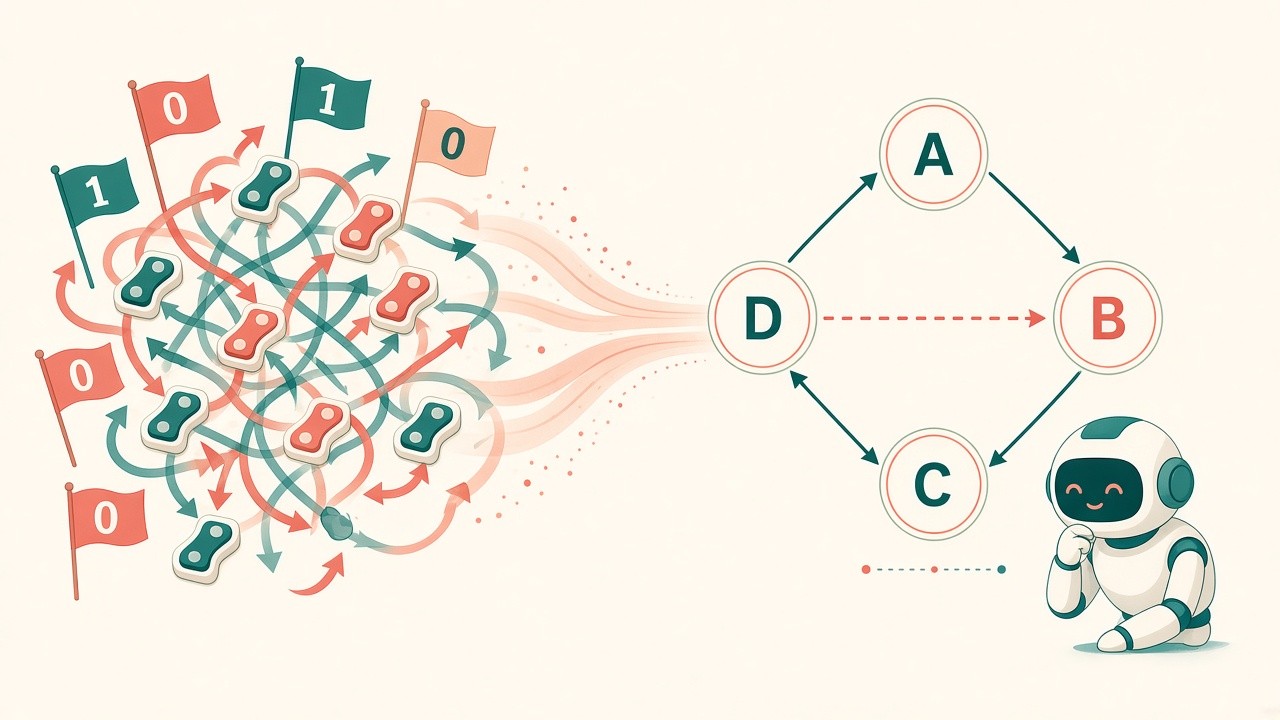
An implicit state machine is a finite set of modes a program already moves through, encoded in flags, variables, control flow or a conversation, rather than as a single named state and a list of legal transitions. According to the NIST Dictionary of Algorithms and Data Structures, a finite state machine has a set of states, a start state, an input alphabet, and a transition function that maps the current state and an input to a next state. Software engineers use "implicit state machine" for that model when it is present in behavior but not written down as one, a phrase NIST's definition does not use.
statecharts.dev calls the hidden form an "implied state machine," because there is no place in the code to point to and say these are the states and how behavior changes. David Khourshid, creator of the XState library, wrote in 2020 that the machines developers write are often "implicitly defined." Flags such as isLoading and isSuccess can both be true at once, he wrote. A machine that defines loading and success as mutually exclusive states rules out that combination.
Implicit versus explicit
In an explicit machine, the allowed states are named in one place, often as an enum or a transition table, and a change of mode checks both the current state and the incoming event. The Redux style guide strongly recommends that a reducer use both the current state and the action to decide whether to calculate a new state, "not just the action itself unconditionally." In an implicit machine, those rules still exist, but they live in scattered assignments and conditionals. Nested if statements and a phase counter can hold the same machine in control flow. A multi-turn assistant can keep "waiting for the user to confirm" only in the chat transcript, with no named status field.
A simple hypothetical example
Consider a hypothetical file-export button tracked with four flags: isExporting, hasError, hasDownload and isCancelled. Those flags can form 16 combinations. In this constructed example, the product only intends five modes: idle, exporting, ready, failed and cancelled. Nothing in the flags themselves stops an export from being marked as both running and cancelled, or a download link from sitting next to an error. A second click or a cancel can race the completion handler. This is the loading-flag problem Khourshid has described. An explicit version would use one status value, attach the download link only to the ready variant, and derive any interface flags from that status rather than store them as a primary source of state, as Khourshid wrote in 2019.
Why it matters for agents
Stately's agent documentation, which the company marks as alpha, walks through a support-triage loop whose modes already sit in nullable variables and an escalated flag. The loop can be correct and still be hard to test, resume, observe or limit, the docs say, because it never names where it is. LangGraph, LangChain's framework for long-running agents, tells developers to define workflows as "graphs of shared state, nodes, and edges" when they need "explicit control over state and control flow." AgenticFeed covered Steve Ruiz's prompt, "find all of the implicit state machines in my app," which asks a coding agent to list those hidden modes before a rewrite.
When explicit state is preferable
Leaving a machine implicit can be reasonable for a single independent toggle, such as whether a menu is open. Khourshid wrote that continuous data such as temperature is extended state, which sits beside a finite mode rather than multiplying it. statecharts.dev says complex implicit machines become unwieldy because the relationships stay in conditional statements. Explicit state is a better fit when modes are mutually exclusive, when some events should be ignored in some modes, when a flow moves money or grants permissions, or when a run must be paused, resumed, tested or inspected. Making the machine explicit does not invent missing product rules. If "complete" could mean a file was written or a customer received a link, a person still has to choose which promise the product makes. The explicit form makes that choice visible and makes illegal combinations harder to represent.
Source: NIST Dictionary of Algorithms and Data Structures, Paul E. Black, “finite state machine”
Additional sources: Wikipedia, “Finite-state machine”; statecharts.dev, “You’re already coding statecharts, they’re just implied”; Stately, David Khourshid, “Redux is half of a pattern (1/2)”; Stately, David Khourshid, “No, disabling a button is not app logic”; Redux, “Treat reducers as state machines”; Stately, “Thinking in state machines”; LangChain Docs, “LangGraph overview”; AgenticFeed, “A one-line prompt that finds hidden state machines in code”