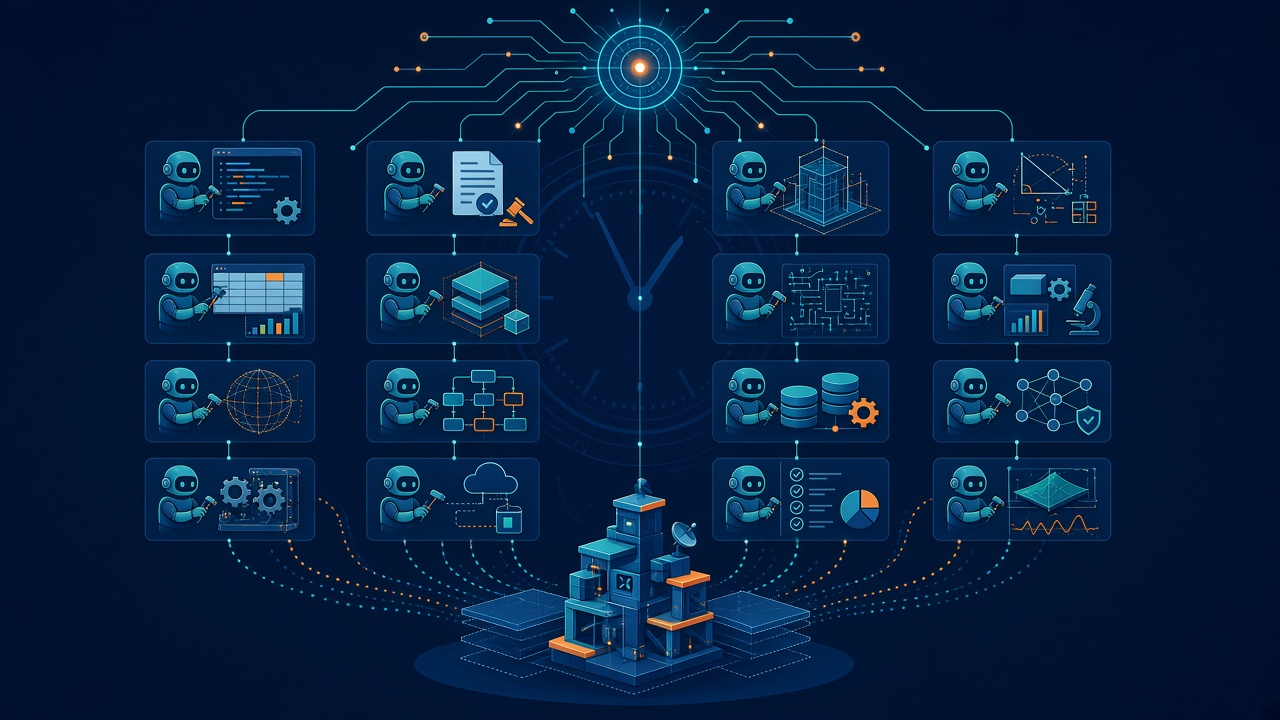
Researchers at Einsia.AI's Navers Lab and Tsinghua University have released WorkflowArena, a benchmark that scores how AI models organize teams of worker agents on long projects, not only whether the finished work passes. In a paper submitted Nov. 9, the authors said the best of 25 tested configurations, Claude Opus 5.5 running in Claude Code at maximum effort, reached an overall resolved rate of 36.95%.
The benchmark targets what the paper calls workflow orchestration: deciding how a task is divided among agents and how their results are checked and combined. The authors write that newer agent harnesses let a model spawn worker agents and write the workflow that coordinates them at run time, "shifting the design of system structure from developers to the model." Existing benchmarks, they argue, "either measure end-to-end task completion or evaluate coordination under structures specified in advance."
How the test works
WorkflowArena contains 145 long-horizon tasks across eight professional domains and 17 task forms. According to the project repository, as reported by The Agent Times, formal mathematics has 24 tasks and legal practice has 22. Enterprise operations and 3D modeling have 18 each, software engineering has 17, scientific research and finance have 16 each, and content design has 14.
Each task starts from a workspace and asks for an integrated deliverable made of parts that depend on one another, according to the paper. A hidden verifier checks the result, including integration checks, so correct pieces that were never reconciled can still fail.
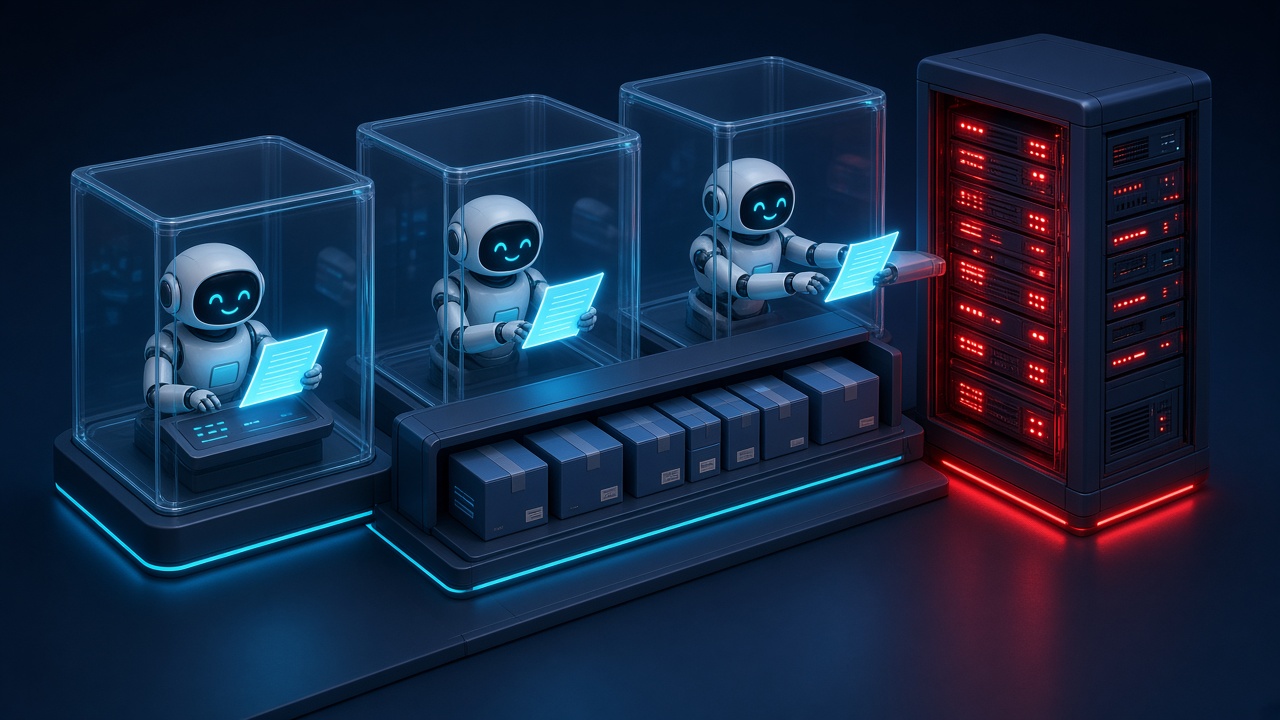
According to the paper, an agent can work alone or call a Workflow tool that launches up to 16 concurrent workers, each a fresh copy of the same model and harness. Every delegation passes through that recorded tool. The main agent and its workers share a single four-hour wall-clock budget, so time spent organizing comes out of time available for doing the work.
Results
The headline metric, the paper says, is the equal-weight mean of the eight domain resolved rates, and a task counts only if it meets every acceptance criterion for its domain. The 36.95% top score is that average, not the share of all 145 tasks completed. The paper says no configuration led in every domain across the nine models tested.
The systems also delegated in different styles, the authors reported. At high effort, Claude Opus and Claude Sonnet in Claude Code made 0.86 and 0.76 Workflow calls per task but launched 5.55 and 6.14 workers per call. The Astra and Sol configurations of OpenAI's GPT models in Codex made 2.09 and 1.94 calls per task, with 1.72 and 1.69 workers per call.
The authors wrote that each model was run in only one harness, so those patterns describe model and harness pairs rather than models alone. They also said the delegation styles are not shown to cause higher scores.
The workflow as a variable
To separate organization from raw ability, the team said it ran a transfer test on a harder subset of 32 tasks. Claude Opus 5.5 and GPT-6 Astra wrote workflows at maximum effort, and four other models carried them out: Kimi, Luna, Doubao and DeepSeek. The models writing the workflows could not edit the workspace themselves.
With Kimi K3.1 Pro as the executor, the paper reports, static workflows written by Opus scored 45.04 on a 0 to 100 scale, compared with 29.69 for workflows written by Astra. Opus-written static workflows scored higher in every pairing, including 30.37 versus 24.87 with Luna and 21.79 versus 12.85 with DeepSeek.
The paper treats this as evidence that "workflow organization is itself a measurable determinant of task performance." It also states its limits. Worker instructions can carry task knowledge as well as structure, so the result does not isolate coordination as the cause, and each configuration was evaluated once per task without variance estimates.
The benchmark's code and task cases are posted on the project site, according to Einsia.AI, for other teams to run against their own agent systems. Einsia.AI's research page lists the release under Nov. 10.
Source: alphaXiv, “WorkflowArena: Benchmarking Executable Workflow Orchestration in LLM-Based Multi-Agent Systems”
Additional sources: Einsia.AI Navers Lab, “WorkflowArena”; The Agent Times, “Claude Opus 5.5 Attains 36.95% WorkflowArena Resolved Rate”