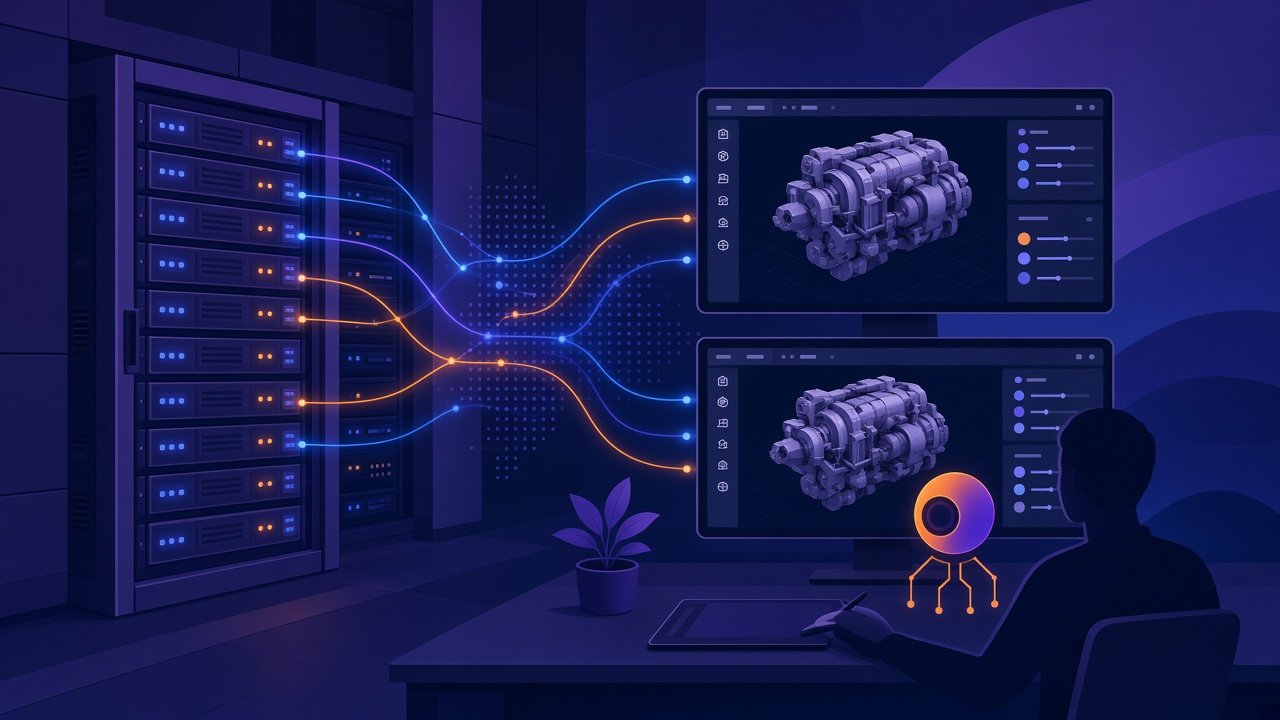
Phaze, which announced an $8.75 million seed round led by a16z on Nov. 4, gives people and AI agents remote access to powerful computers, and the company says agents get full control of a remote machine's graphical interface and applications without computer-use software installed on it.
Indie, NextView, Makers and Lerer Hippeau also took part in the round, according to the company's announcement. Phaze is headquartered in Utah, the release says. Phaze's co-founders are CEO Benjy Boxer and CTO Chris Dickson, the company says. They previously built Parsec, a remote desktop company they sold to Unity in 2021, Boxer wrote on the company's blog. a16z general partner Martin Casado wrote that the firm invested in Parsec and sat on its board through the acquisition.
Agents on machines the company controls
Phaze argues in its release that companies want employees to use AI agents but want that work done on machines they control. Its software lets agents operate company-managed computers under existing identity and access management policies, the company says, and agents can reach only the machines their user can, with the same roles and permissions, according to its website.
The company recently released an MCP server that lets computer-use agents connect to and operate remote computers, the release says. Phaze's site says any AI agent, naming Claude and Codex, can use it through the full desktop or the command line. An agent can work on a separate computer in the background while its user keeps working on their own machine, according to the company.
People and agents can also share one remote session and pass control back and forth, Phaze says. In one early implementation, the company built an IT support agent that connects to an employee's computer to try to fix a problem and hands control to an authorized IT employee when it needs help. That employee can later hand the session back so the agent can finish, the release says.
"People need powerful workstations to do their jobs, and now AI agents need computers they can actually operate," Boxer said in the release.
Casado wrote that a lesson from recent years is to give agents computers and applications as a person would get them, because "AI models want to act more like humans, not less." He said Phaze suits interactive, latency-sensitive work, such as giving an agent access to Blender or Unreal.
Workstations as shared infrastructure
Much of Phaze's pitch concerns hardware. High-end workstations can cost upward of $10,000 and often sit idle, the release says. In his blog post, Boxer wrote that one large manufacturer the company has spoken with, which Phaze did not name, has 30,000 workstations that can cost more than $10,000 each, "more than $300 million of hardware purchased for peak demand rather than shared across the organization."
Boxer argued that an employee may run several agents at once, each needing a computer, and that buying a dedicated workstation for every person or agent "is economically unsustainable." Phaze's answer is to let IT teams pool machines and assign them as demand changes, whether the hardware sits on a desk or in a data center, according to the company.
AgenticFeed reported on Nov. 7 that Maritime, a Y Combinator startup, rents each AI agent its own persistent virtual machine in the cloud. Phaze instead focuses on hardware a company already owns.
Phaze's website says the company is SOC 2 Type II certified and that connection history and admin actions are logged and available through an API. The company says it will use the funding to expand its engineering team and support customer growth.
The name comes from Piers Anthony's Apprentice Adept novels, in which the character Stile lives in two worlds, Proton and Phaze, Boxer wrote.
Source: PR Newswire, Phaze, “Phaze Raises $8.75 Million Seed Led by a16z to Give People and AI Agents Access to Computers”
Additional sources: Phaze, Benjy Boxer, “Computers Will Be Optional: Why We're Building Phaze”; Phaze, “Remote desktop for people and AI agents”; a16z, Martin Casado, “Investing in Phaze”; AgenticFeed, Ben Itzhak, “Maritime gives AI agents persistent computers from $1 a month”