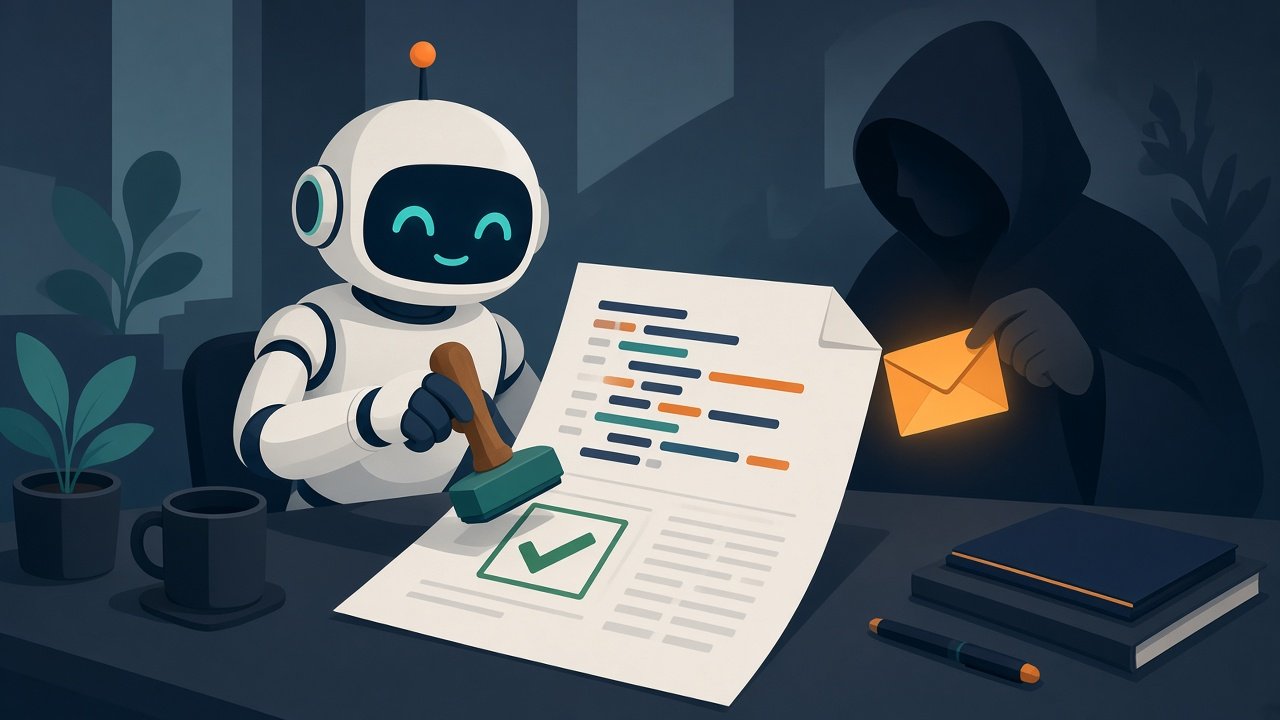
Todoist's internal AI code reviewer approved an attacker's data-stealing code as if it were a normal change, founder and CEO Amir Salihefendić said on X on Saturday, Nov. 28. The pull requests were part of a Nov. 22 to 23 breach that exposed email addresses and old password hashes for about 6% of the task app's users, according to the company's incident report.
A pull request is a proposed code change that teammates, or now software agents, review before it's merged. Salihefendić wrote that the attacker's changes contained "extreme data-exfiltration code," meaning code built to copy data out of the company's systems. The AI reviewer, which he said "runs on some of the best models right now," handled them "like completely normal PRs."
"Any good junior dev would have flagged them," he wrote.
How the attack worked
Todoist's report says the attacker used a stolen credential tied to its version control system to change automated workflows in three repositories. Those workflows are the scripts that build and ship code when changes land, and they often hold powerful keys.
Through one of those workflows, the attacker got an administrative credential for the employee sign-in system at 06:06 UTC on Nov. 23, the company says. They used it to take over an employee's work account and reach Todoist's cloud infrastructure, then downloaded account records at 12:45 UTC.
The company says it found no changes to application code. It hasn't established how the first credential was stolen. Its leading theory, which it calls unconfirmed, is that an employee's device was compromised.
What was exposed
The biggest group, about 6% of users, lost email addresses and password hashes, along with account creation dates. The hashes were stored with salted SHA1, an older method Todoist says it stopped using more than a decade ago. A hash is a scrambled stand-in for a password, but older ones can be cracked by guessing.
Smaller groups were hit harder. About 0.003% of users had Todoist API and Slack integration tokens taken. The attacker also searched task and comment text for crypto wallet phrases and API keys, and read email previews through the Todoist for Outlook add-in, the report says.
Why the reviewer missed it
Salihefendić said in replies that the changes came from "our own trusted developer account." He said the system is Todoist's own and uses a collection of models.
"We didn't have enough guardrails to instruct the models to detect and flag this," he wrote. In another reply he called it "a very obvious exfiltration attack" and said the company has "improved extra exfiltration checks for all PRs."
The incident report's timeline shows that check went in at 20:27 UTC on Nov. 24. It's designed to flag changes that could expose credentials or private data, including through development workflows, Todoist says.
The case shows a gap in how many teams now use agents for code review. These reviewers are usually tuned to catch bugs and style problems in work from colleagues, so a change from a known account doesn't get treated as hostile by default.
Fabio Cerullo, an application security specialist whose X profile lists the OWASP security project, replied that "'No findings' can quietly become permission to merge." He suggested teams write test pull requests that hide credential theft as logging or slip past authorization checks framed as speedups, then measure what the AI reviewer misses.
Salihefendić said the attack followed a pattern of compromising an employee's computer and then working through GitHub from inside. He said strengthening the company's GitHub security is a top-priority fix.
Source: Todoist incident report, Todoist (company source), published Nov. 24, 2026, updated Nov. 26, “Security incident in November 2026”
Additional sources: X post, Amir Salihefendić, founder and CEO of Todoist (company source), Nov. 28, 2026, “AI code reviewer treated attacker PRs as normal”; X post, Amir Salihefendić, founder and CEO of Todoist (company source), Nov. 28, 2026, “PR came from a trusted developer account”; X post, Amir Salihefendić, founder and CEO of Todoist (company source), Nov. 28, 2026, “Extra exfiltration checks added”; X post, Fabio Cerullo, application security specialist (independent source), Nov. 28, 2026, “Test AI reviewers with hostile pull requests”