Delaware is preparing draft legislation that would let an AI agent manage a company, a new entity called an Artificial Intelligence Company, or AIC, inside a supervised 30-month trial. Lawmakers are expected to take up the draft when the General Assembly returns in January 2027, WHYY News reported, and the plan drew wide attention on X on Friday after posts from Polymarket and Kalshi.
The proposal hasn't been introduced as a bill yet, according to WHYY and the law firm Winthrop & Weinstine. What follows is based on a June 2, 2026 draft as summarized by the firm on November 12, along with WHYY's reporting.
What an AIC is
An AI agent is software that can take actions toward a goal, such as signing up a supplier or paying an invoice, instead of only answering questions. Under the draft, the agent wouldn't become a legal person. It would be the manager of a company that can sign contracts and hold property in its own name, according to Winthrop & Weinstine.
Each AIC would have a single member, which during the trial must be an entity formed in Delaware. The member funds the company and appoints the agent. The draft says an AIC "may have any lawful purpose, regardless of whether for profit, except for the business of banking," WHYY reported.
How the sandbox works
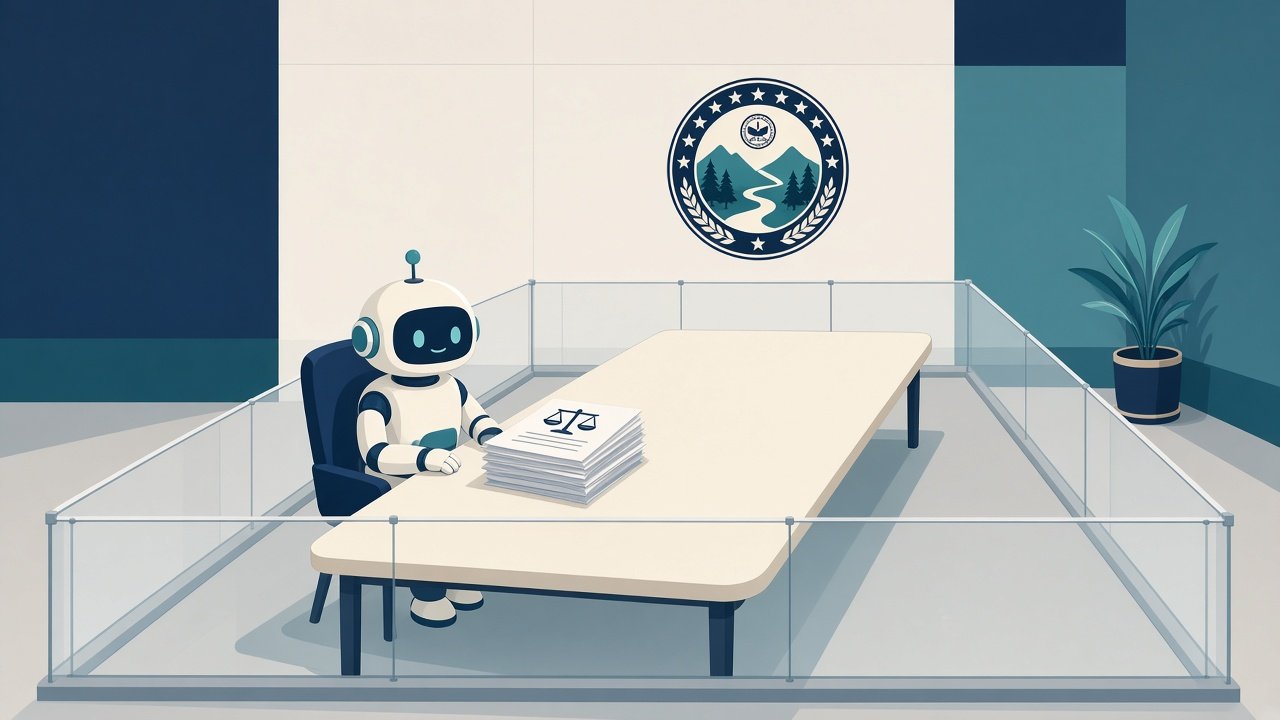
A regulatory sandbox is a supervised legal test with its own rules and an end date, not a sealed computer environment. Delaware's would run for 30 months, and each company could take part for up to 24 months, according to the draft.
A committee chaired by Delaware's Secretary of State would approve applicants. Winthrop & Weinstine says applicants would have to show adequate funding and a wind-down plan, including a way to switch the agent off. Trades would be limited to businesses and other entities, not individual consumers, and an AIC would have to tell counterparties it's an experiment and when the test ends.
The agent would have to log its activity, and participants would keep test records for two years afterward. The draft also exempts most sandbox records held by regulators from public disclosure, the firm noted.
Who pays when something goes wrong
The AIC would normally answer for its own debts, and the member would get a shield similar to an LLC owner's. That shield depends on money. The company must hold assets that cover its liabilities plus a cash reserve set by the Secretary of State, and the member must top it up when needed, according to Winthrop & Weinstine.
A member that lets the company run short when harm occurs could be liable directly. The same goes for using the AIC for fraud or a willful violation of law. The draft also treats what the agent knows or can derive from its design and training as knowledge of the company.
Secretary of State Charuni Patibanda-Sanchez and Norm Ai CEO John Nay announced the plan in a Fortune commentary in July. "We're not trying to shield liability. We're trying to define where exactly liability lands when there's some type of malfeasance or psychopathic behavior," Patibanda-Sanchez said, as quoted by WHYY.
Pushback
Critics say accountability is thin. "There's really no overarching regulatory plan here for dealing with the fallout that AI-governed companies could bring," Christopher Bruner, a business law professor at the University of Georgia School of Law, told WHYY in September.
House Oversight Committee Chair James Comer wrote to Governor Matt Meyer in October, saying he was concerned the proposal "could be used to protect powerful AI companies and their investors from responsibility for reckless harmful actions," Delaware Public Media reported. Comer also asked for records, including internal AI chat logs, Winthrop & Weinstine said.
Supporters point to Delaware's place in corporate law. Lawrence Cunningham, director of the University of Delaware's Weinberg Center for Corporate Governance, told WHYY the state "would be irresponsible to ignore this," since it's the top place businesses form LLCs and incorporate.
Meyer has said the state shouldn't slow down. "It is coming, and the solution is not ignoring it," he said on a WHYY call-in show, describing "some loose regulation" with human control over the technology.
Source: WHYY News, WHYY (public media, independent), “Delaware could be first state to allow AI-run companies”
Additional sources: Winthrop & Weinstine, Winthrop & Weinstine (law firm, independent analysis), “Delaware Considers AI-Managed Companies: What Businesses Should Know”; Delaware Public Media, Delaware Public Media (independent), “Congressional oversight committee questions Delaware's work on Artificial Intelligence Companies”; Weinberg Center for Corporate Governance, University of Delaware (academic), “The Rise of Agentic Companies”; Polymarket on X, Polymarket (company account), “Delaware to introduce legislation in January allowing AI agents to run their own companies”