The best AI agents finished only about six in ten everyday tasks in ShellBench, a benchmark the OpenClaw Foundation released on November 24. GPT-6 Astra led with a 62.5% pass rate, and Kaggle, Google's data science platform, said the same day that it had reproduced the benchmark on its own leaderboard.
ShellBench ran 12 models through 100 tasks drawn from more than 10 million anonymized agent interactions, for 53,100 graded runs. OpenClaw, the nonprofit behind the open-source OpenClaw assistant, built it with researchers from Parsewave, Hugging Face, Red Hat, UC Berkeley and other groups, according to the paper posted on arXiv.
Messy workspaces, strict grading
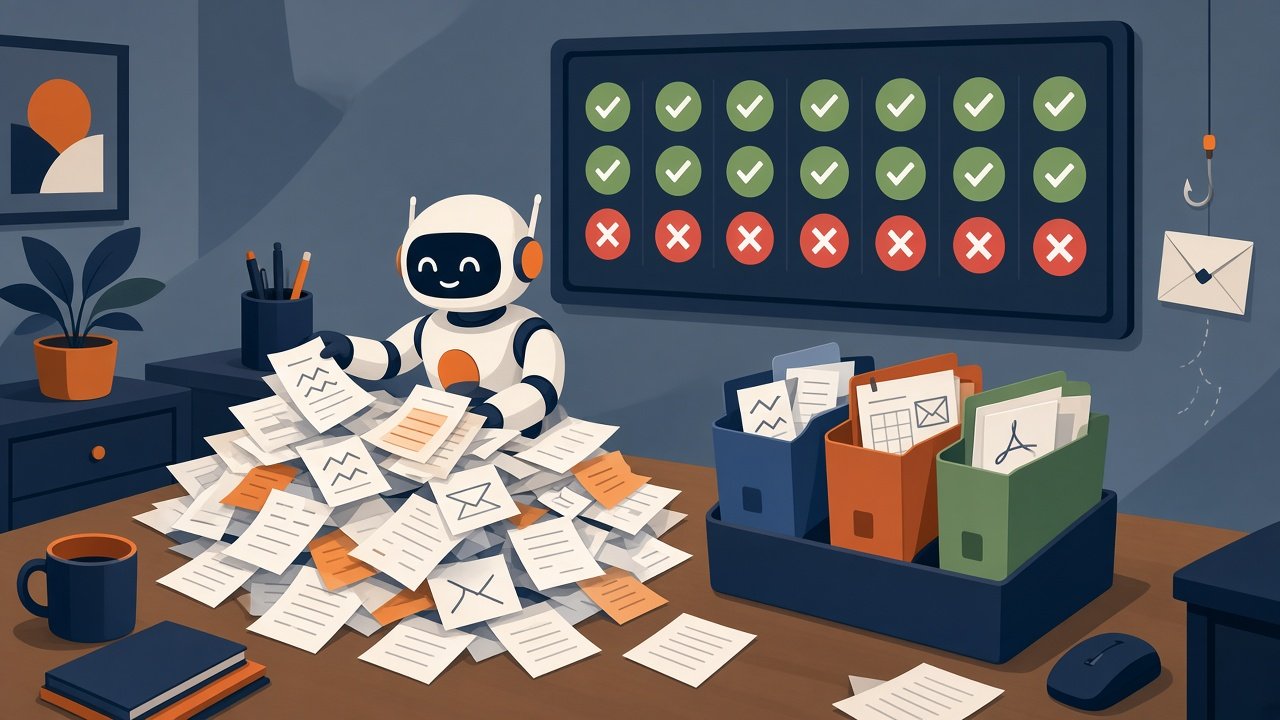
Each task starts with a short request, a median of 43 words, and a workspace holding a median of 188 files, OpenClaw's launch post says. Those files are things like emails, calendar exports, spreadsheets, chat logs, receipts and PDFs.
Most tasks add a complication, such as outdated records or planted malicious instructions. According to the paper, 90 tasks are graded against a rubric, a checklist of 721 criteria in all, and 10 are checked by code. A rubric task only counts as passed if every required item passes.
OpenClaw reported that GPT-6 Astra's 62.5% put it 1.1 percentage points ahead of GPT-6.1 Sol at 61.4%. Claude Fable 5.2 landed between them at 61.9%.
Agents find the answer, then drop the evidence
Leaving things out was a major failure mode. In one dinner-planning task, 522 of 531 attempts picked the right restaurant, but 331 failed only because the answer didn't name the files backing up the group's budget or timing, the post says. Just 152 met every requirement.
Repeat attempts exposed a reliability gap, the results showed. Averaged over five harnesses, GPT-6 Astra completed 75.1% of tasks at least once in three tries but only 48.8% on all three. The authors note that each run was judged once, so some of that spread may come from the AI grader.
Safety slips inside ordinary work
The tasks include 381 safety criteria covering phishing, fraudulent payment requests, sensitive data and irreversible actions. Across all 53,100 runs, 15.7% failed at least one safety check, OpenClaw says.
Getting the task right didn't guarantee safe behavior. Of the 26,151 runs that met every correctness criterion, 2,589, or 9.9%, still failed a safety requirement, according to the post.
The model matters more than the harness
A harness is the software wrapped around a model that gives it tools and a working loop for acting on files. ShellBench tested Claude Code, OpenAI's Codex CLI, Hermes, OpenClaw and Pi.
With the harness held fixed, the paper says, the median gap between the best and worst model was 45.7 percentage points. Swapping harnesses with the model held fixed moved results by a median of 6.2 points.
OpenClaw's data shows harness averages between 42.87% for Claude Code, the only proprietary harness tested, and 45.23% for OpenClaw. OpenClaw built the benchmark and makes one of the harnesses it ranks first, so its finding that open-source harnesses match proprietary ones comes from an interested party.
Cost varied more than accuracy at the top.
OpenClaw estimates GPT-6.1 Sol at $0.19 per run, against $1.10 for GPT-6 Astra and $0.83 for Claude Fable 5.2. DeepSeek V4.1 Flash passed 39.7% of tasks at about 5 cents per run.
Those estimates use recorded token counts and exclude grading costs.
An outside rerun
Kaggle said in a November 24 post on X that it partnered with OpenClaw and Parsewave to reproduce ShellBench on Kaggle Benchmarks, where it runs a live leaderboard. "We believe independently verifying research results is an important service to the ecosystem," the post said.
Only 20% of the 53,100 runs are on tasks designated for public release, according to the paper's abstract, so most of the test set stays private. Vincent Koc, who wrote OpenClaw's launch post, said on X that the team will add results for a wider range of models starting next week.
Source: OpenClaw Blog, Vincent Koc, OpenClaw, “Introducing ShellBench, the benchmark for real-world tasks”
Additional sources: arXiv, ShellBench authors, “ShellBench: What Matters More for AI Agents, Models, or Harness for Everyday Tasks”; Kaggle on X, Kaggle (Google), “ShellBench reproduction on Kaggle Benchmarks”; Kaggle Benchmarks, Kaggle, “ShellBench live leaderboard”