Andreessen Horowitz partners Olivia Moore and Justine Moore published test results on November 23 showing that AI shopping agents pick from narrow shortlists and lean hard on price and reviews. The venture firm ran the tests with The Prompting Company, covering 11,307 completed runs across 1,270 prompts on four consumer agents: Grok Bot, Muse, Instinct and Dots.
The essay, "Welcome to the B2A Economy: How Agents Buy," is the second in the partners' series on businesses selling to AI agents rather than people. B2A stands for business-to-agent. The tests ran from October 22 to November 8, according to the methodology note, plus 2,619 shopping requests on other chatbots, including ChatGPT and Gemini, for comparison.
Agents agree on defaults
A product picked by one agent had a 73% chance of being picked by at least one other agent, the authors wrote. In nearly a quarter of cases, all four agents chose the same top product.
Muse is the only agent that fully exposes its research logs, according to the essay. Those logs show it starts with a search of Meta's own catalog, pulls at most 50 options and, when it does browse the web, looks at three product pages on average.
Specific needs can flip the pick. Asked to choose between the Shark FlexStyle and the Dyson Airwrap hair tools, agents chose the cheaper Shark in 91% of runs, but Dyson's winning share rose to 88% when the user said they'd use it daily.
Agents do the math
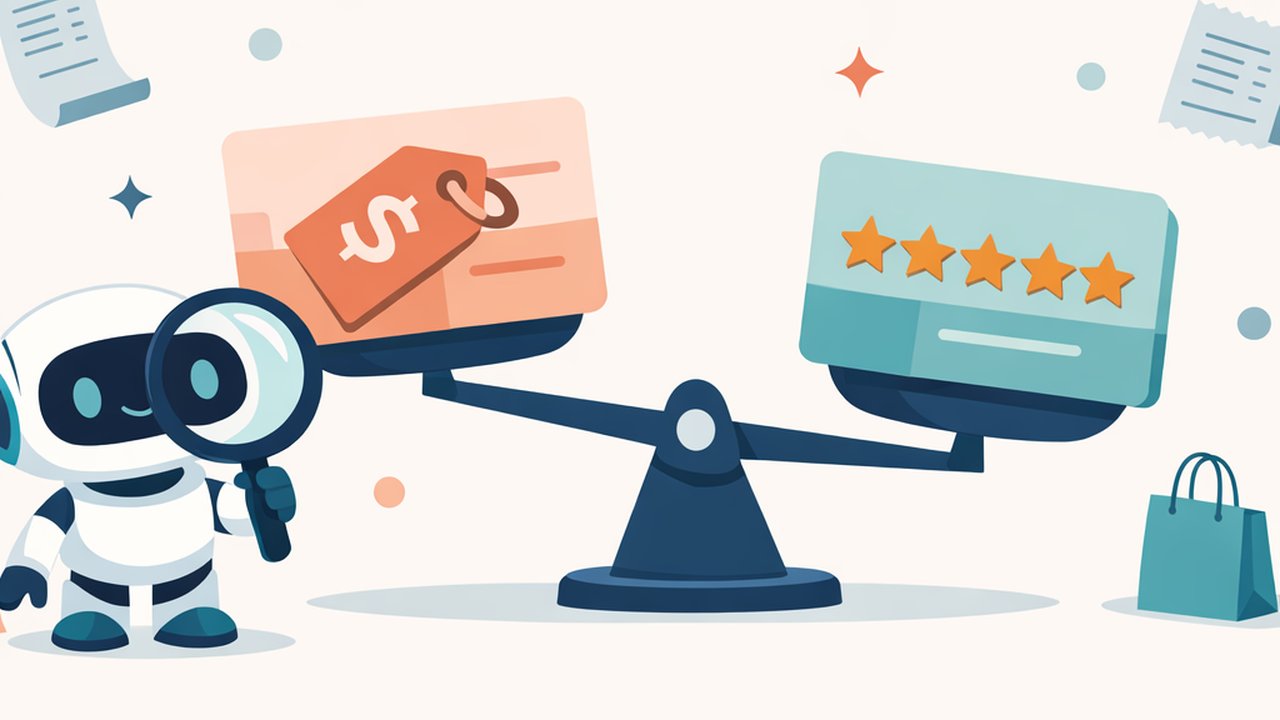
The partners wrote that agents are "ruthless optimizers" that add up shipping fees, subscription terms, return policies and even warranties. When two retailers offered a product at the same price, agents picked the one with the better return policy in 86% of tests.
Trust still matters. Across 275 real-store comparisons between a cheaper seller and a pricier but more trusted one, agents recommended the trusted option 72% of the time, the essay says. Discounts under 10% didn't sway them, and they avoided offers more than 50% below the trusted price.
Domain registrar Porkbun ranked ninth by number of agent transactions and first in technology, ahead of Cloudflare at 17th and GoDaddy at 112th, according to spending data from YipitData cited in the essay. The authors credited Porkbun's flat pricing with no cheap first year that jumps later.
Each agent shops differently
Bot-blocking shapes results. In Amazon checkout tests, Grok Bot reached the cart in every run, while the other three agents were blocked in all of their attempts, the authors wrote.
Grok Bot linked to Amazon in 17.5% of runs, and no other agent topped 1.6%, the essay says. Muse linked to Walmart in 26% of answers and Best Buy in 22%.
Agents also rarely used connectors, the plug-ins that link an agent to outside apps. Grok Bot offered to connect an app in 5% of runs, and the other three did so in under 1%, according to the authors.
Agents reached the end of the checkout form in 81% of runs on stores with guest checkout. Every run on a store that required a logged-in account stopped early, according to the essay.
Travel made up the largest share of agent spending so far, the authors wrote. In YipitData's sample, Expedia and Booking.com were the two largest merchants by spend. Nearly one-third of spending among the top 50 merchants went to marketplaces and aggregators.
Who ran the tests
The findings come from a venture firm that invests in AI companies and a partner company that counts Nvidia and Google among its customers, and they haven't been independently replicated. YipitData's card-panel figures cover purchases through November 11 and exclude Amazon, the methodology note says. They also don't separate Muse from Instinct.
The authors wrote that they see a big opportunity for startups that help businesses market and sell to agents.
Source: Andreessen Horowitz, Olivia Moore and Justine Moore, “Welcome to the B2A Economy: How Agents Buy”
Additional sources: Andreessen Horowitz, Olivia Moore and Justine Moore, “Welcome to the B2A Economy”